Key Takeaways
Agentic AI represents a fundamental shift in artificial intelligence. Agentic AI has moved from responding to prompts to autonomous agents that independently plan, reason, and execute complex tasks to achieve specific goals with minimal human supervision.
• Agentic AI operates autonomously through six stages: data perception, reasoning, goal setting, decision-making, action execution, and continuous learning—enabling it to handle multi-step workflows without constant human intervention.
• Unlike generative AI that creates content, agentic AI takes action—it doesn't just produce outputs for you to use, but actively executes tasks, makes decisions, and adapts strategies in real-time to achieve defined objectives.
• By 2028, 15% of daily work decisions will be made autonomously through agentic AI systems, transforming industries from customer service to healthcare through capabilities like tool integration and multi-agent collaboration.
• Real-world deployments show dramatic results: companies report 40% increases in customer engagement, 60% reductions in incorrect advice, and 30% faster task completion when implementing agentic AI solutions.
The combination of generative and agentic AI creates maximum value—generative models provide the cognitive reasoning engine while agentic frameworks handle execution, memory, and coordination across systems. Organizations should start by identifying repetitive, multi-step processes as prime candidates for agentic automation to deliver measurable efficiency gains.
By 2028, 15% of day-to-day work decisions will be made autonomously through agentic AI, up from 0% in 2024. This shift represents a fundamental change in how AI operates—moving from systems that assist to systems that act independently. Agentic AI can make decisions, plan actions, and execute tasks with minimal human intervention, transforming how you interact with technology.
In this guide, I'll break down the agentic AI definition and meaning, explain how it works, compare agentic AI vs generative AI, and explore real-world agentic AI tools you can use today.
What is Agentic AI? (Definition and Meaning)
Agentic AI is an autonomous AI system that can accomplish specific goals with limited supervision. Unlike traditional AI that requires prompting and step-by-step guidance, agentic AI operates independently to perceive, reason, and act in digital environments on behalf of human users.
We’re defining agentic AI as systems that can plan autonomously and take actions to meet goals.
— Tom Coshow, Senior Director Analyst at Gartner
The agentic AI meaning centers on autonomy and goal-driven behavior. These systems consist of AI agents—machine learning models that mimic human decision-making to solve problems in real time.
When you assign a task, agentic AI breaks down the goal into smaller steps, evaluates options, and determines the best sequence of actions to achieve the outcome.
An agentic AI system doesn't just respond to a single prompt. It plans, reasons, and acts using tools and workflows to move toward a defined objective. For instance, an agentic AI could optimize employee shift schedules by communicating with other employees and readjusting assignments when someone calls in sick, while still meeting project resource and time requirements.
Agents execute multi-step plans, use external tools, and interact with digital environments to function as powerful components within larger workflows. They can search the web, call APIs, query databases, then use this information to make decisions and take actions.
Why the Term 'Agentic'
The term "agentic" refers to their capacity to act independently and purposefully. This describes systems that behave like agents, entities capable of making decisions, taking actions, and adapting to achieve a goal.
Agentic AI represents a shift from reactive AI to goal-driven systems that can operate autonomously. Traditional software follows pre-defined rules, but agentic systems make independent contextual decisions. They learn from their environment and adapt to changing conditions, enabling them to perform sophisticated workflows with accuracy.
Core Principles of Agentic Systems
Agentic systems maintain long-term goals, manage multistep problem-solving tasks, and track progress over time. They provide the flexibility of LLMs with the foundations of traditional programming.
Agents begin work with either a command from you or through an interactive discussion. Once the task is clear, they plan and operate independently, potentially returning for further information or judgment. During execution, agents gain "ground truth" from the environment at each step—such as tool call results or code execution—to assess progress.
The basic building block of agentic systems is an LLM enhanced with augmentations such as retrieval, tools, and memory. These systems can employ APIs to communicate with other agents and humans, receive and send money, and access and interact with the internet.
Agents can learn from their experiences, take in feedback, and adjust their behavior. With appropriate guardrails, agentic systems improve continuously. In a multiagent system, each agent performs a specific subtask required to reach the goal, and their efforts are coordinated through AI orchestration.
How Agentic AI Works
Agentic AI operates through a structured workflow that transforms it from a passive model into an active problem-solver. The system moves through six interconnected stages, each building on the previous to create autonomous decision-making capability.
- Data perception and collection
- Reasoning and analysis
- Goal setting and planning
- Decision-making process
- Action execution
- Learning and continuous development
1. Data Perception and Collection
Agentic AI begins by gathering raw data from its environment through sensors, APIs, databases, and user interactions. This sensory input collection forms the foundation for all subsequent actions. The system processes structured, semi-structured, and unstructured data in real time.
During data processing, the AI removes noise and highlights important features. For example, computer vision models analyze images to detect objects and movements, while natural language processing transforms audio waves into text. The system determines what information is useful based on the task context.
2. Reasoning and Analysis
Once data is collected, the AI processes it to extract meaningful insights. Large language models serve as the reasoning engine, orchestrating decision-making and coordinating specialized models for tasks. The system interprets user queries, detects patterns, and understands broader context to determine appropriate actions.
Two common reasoning paradigms include ReAct (Reasoning and Action) and ReWOO (Reasoning Without Observation). ReAct employs a think-act-observe strategy to solve problems step-by-step, while ReWOO plans ahead before formulating a response. Techniques like retrieval-augmented generation improve accuracy by allowing the system to access proprietary data sources.
3. Goal Setting and Planning
The AI sets objectives based on predefined goals or user inputs, then develops a strategy to achieve them. Task decomposition breaks complex goals into smaller, manageable sub-goals. For instance, when planning a trip, the agent decomposes the task into components such as booking flights, finding hotels, and planning an itinerary.
Planning agents anticipate future states and generate structured action plans before execution. They identify potential actions, prioritize them, and recognize dependencies between steps. This structured approach ensures the agent covers all necessary areas without unnecessary repetition.
4. Decision-Making Process
AI evaluates multiple possible actions and chooses the optimal one based on efficiency, accuracy, and predicted outcomes. The system uses probabilistic models, utility functions, or machine learning-based reasoning to determine the best course of action.
Decision-making logic balances trade-offs, risks, and expected outcomes. Context awareness allows the system to adjust decisions based on situational factors like timing, environment, and constraints. This ensures outputs remain relevant rather than generic.
5. Action Execution
After selecting an action, the AI executes it by interacting with external systems through APIs, databases, or robots. Built-in guardrails regulate actions, ensuring compliance with predefined rules. The system orchestrates several subtasks sequentially, with actions ranging from compiling code to running simulations.
All actions are closely monitored and logged, allowing organizations to align with governance standards. For high-stakes decisions, human-in-the-loop systems require verification before execution proceeds.
6. Learning and Continuous Improvement
After executing an action, the AI evaluates outcomes and gathers feedback to improve future decisions. Through reinforcement learning techniques like proximal policy optimization and Q-learning, the system refines actions based on task success. The agent tracks performance using metrics including latency, confidence, and success rate.
This feedback loop enables the system to adapt without being explicitly reprogrammed for each new scenario. Multi-agent systems distribute learning across different agents, sharing information in communal memory layers to enhance overall performance.
Key Capabilities That Set Agentic AI Apart
Four core capabilities distinguish agentic AI from conventional automation and set the foundation for its autonomous behavior. These features enable systems to operate independently while adapting to complex, unpredictable environments.
Autonomous Operation
Agentic systems complete tasks end-to-end without constant approvals or manual handoffs. Three core characteristics define this autonomy: minimal supervision, adaptability, and context awareness. Rather than executing fixed scripts, these systems evaluate context, choose a plan, act, and learn from feedback to improve future performance.
The distinction from traditional automation is fundamental. Traditional automation is rule-based and deterministic, following a script or fixed workflow with limited flexibility. Agentic systems are goal-based and dynamic, selecting among options and handling edge cases through experience. A support agent identifies a customer issue, opens a case, retrieves context from CRM, drafts and sends a solution, and follows up—escalating complex cases with a complete audit trail.
Adaptability to Changing Environments
Agentic AI processes and responds to new scenarios in real time, reducing failure rates in dynamic environments. Self-driving cars adapt to unexpected road conditions as they occur. Adaptive AI incorporates reinforcement learning and real-time feedback for continuous improvement, with chatbots learning from user interactions to refine responses over time.
The ability to adjust strategies in response to new data, conditions, or performance signals separates truly intelligent systems from rigid automation. Adaptive AI combines agent-based design and reinforcement learning concepts to learn patterns of behavior based on previous human and machine experience. It operates on principles of robustness, efficiency, and agility—dynamically changing operating conditions based on evolving requirements.
Tool Integration and Usage
Tools turn a language model from a text generator into an agent that interacts with live systems. Without tools, an agent remains a fluent writer with no hands. Agent tools are functions and services that help AI agents call APIs, query databases, send messages, and run workflows.
These platforms handle authentication, tool execution, permissions, and logging so agents can call tools deterministically with clear inputs and outputs. The Model Context Protocol standardizes how AI applications discover and invoke tools, resources, and prompts exposed by servers. Type-safe tool interfaces provide strict input/output schemas, preventing agents from guessing parameters or chaining multiple API calls to accomplish tasks.
Multi-Agent Collaboration
Multi-agent systems enable decentralized, autonomous agents to work together to achieve collective or interdependent goals. The coordinated actions of several independent agents in a distributed system—each having local knowledge and decision-making capacities—handle complex real-world tasks such as customer service triage, financial analysis, and compliance monitoring.
Agents cooperate using established communication protocols to exchange state information, assign responsibilities, and coordinate actions. Distributed problem-solving breaks down complex tasks into smaller subtasks that specialized agents handle. This architecture provides extensibility and robustness—as problem scope increases, you add more agents rather than optimize a monolithic agent packed with instructions and tools.
Agentic AI vs Generative AI
What Generative AI Does
Generative AI creates new content in response to prompts. It produces text, images, code, audio, and video by learning patterns from large datasets. These systems excel at single-turn creative tasks where the full scope fits within one inference call.
The technology operates on a reactive, prompt-response model. You provide input, the model generates output, and the process ends. Gen AI waits for specific human direction, analyzes the request, and produces a single output. It doesn't inherently understand goals beyond the current prompt.
Large language models power these systems by predicting the next logical element in a sequence. For text, this means predicting the next word to create coherent sentences. Image generators predict pixels to construct visuals. The models identify and encode patterns in huge amounts of data, then use that information to understand natural language requests.
Generative AI adapts outputs based on user feedback. If you provide specific feedback to the model, the outcome shifts to align more closely with what you seek. This adaptability applies to content style, format, and tone—but not to autonomous task execution.
What Agentic AI Does Differently
Agentic AI executes tasks and makes decisions autonomously rather than creating content on demand. It pursues goals through multi-step reasoning without requiring continuous human direction. The system is proactive, operating toward objectives while maintaining context across steps and adapting plans as conditions change.
Whereas generative AI produces output for you to act upon, agentic AI takes the actions itself. The technology operates through a perceive-plan-act cycle. It perceives context through data sources and memory, plans by decomposing high-level goals into discrete subtasks, and acts by calling external tools or writing outputs to downstream systems.
AI agents make decisions dynamically at each step—evaluating outputs, checking conditions, and adjusting approach. The system takes responsibility for the sequence of decisions required to reach a goal, monitoring progress and recovering from errors. This contrasts sharply with generative AI's bounded, single-inference approach.
How They Work Together
The two technologies achieve maximum power in combination. Generative models serve as the cognitive engine for agentic AI—the LLM reasons about goals and produces text-based outputs at each workflow step, while the agentic framework handles execution, memory, and coordination across multiple systems.
For instance, a market intelligence agent receives a goal: summarize competitor activity this week. The agent breaks this into subtasks—querying news APIs, pulling structured data, formatting a digest. At each subtask, it invokes a gen AI model for summarization, then routes the result downstream. This separation of concerns scales effectively: gen AI for generation quality, agentic AI for orchestration and autonomy.
Tools and Applications of Agentic AI
AI agents will become the primary way we interact with computers in the future. They will be able to understand our needs and preferences, and proactively help us with tasks and decision-making.
— Satya Nadella, CEO of Microsoft
Companies across industries deploy agentic AI to automate complex workflows that traditionally required extensive human coordination.
Customer Service and Support
Agentic AI handles end-to-end customer interactions without human handoffs. RV retailer Camping World increased customer engagement by 40% while reducing wait times from hours to 33 seconds. Uber's Genie copilot uses enhanced agentic RAG, boosting acceptable answers by 27% and cutting incorrect advice by 60%.
Sales and Marketing Automation
AI agents qualify leads, personalize outreach, and manage pipeline activities autonomously. LinkedIn's Hiring Assistant uses a multi-agent system where specialized sub-agents handle job descriptions, candidate sourcing, and messaging coordination. Salesforce Ask Astro enables event attendees to receive session recommendations and schedule management through natural-language queries.
Supply Chain Management
Organizations with higher AI investment in supply chain operations report revenue growth 61% greater than peers. By 2026, 70% of executives expect employees to analyze data in real time as AI agents automate operational processes. Process efficiency improves as agents perform repetitive tasks faster than humans can.
Healthcare and Diagnostics
AI agents assist clinicians with documentation, surface relevant patient information, and coordinate scheduling across multiple systems. These systems handle appointment management, intake processes, and ongoing patient communication while operating within HIPAA compliance boundaries.
Financial Services and Trading
Moody's Research Assistant users consume 60% more research while completing tasks 30% faster. Over 90% of AI interactions focus on high-value analytics rather than basic retrieval. Agents monitor markets, detect correlations, and optimize portfolio allocations continuously.
Cybersecurity
Agentic AI monitors network traffic continuously, analyzes user behavior, and detects anomalies indicating malicious activity. Upon threat detection, systems isolate compromised endpoints, block malicious IP addresses, and trigger security team alerts autonomously.
In summary
Agentic AI represents a fundamental shift from systems that assist to systems that act independently. As these autonomous agents evolve from handling simple workflows to making complex decisions, they'll transform how you operate across customer service, sales, supply chain, and beyond.
The distinction between generative and agentic AI matters because it determines whether you're getting content or getting results. Therefore, choosing the right application for each use case will maximize your return on AI investment.
Start by identifying repetitive, multi-step processes in your organization. These represent the best opportunities for agentic automation, delivering measurable efficiency gains while your team focuses on strategic priorities that require human judgment.
Try Echo for your customer service operations
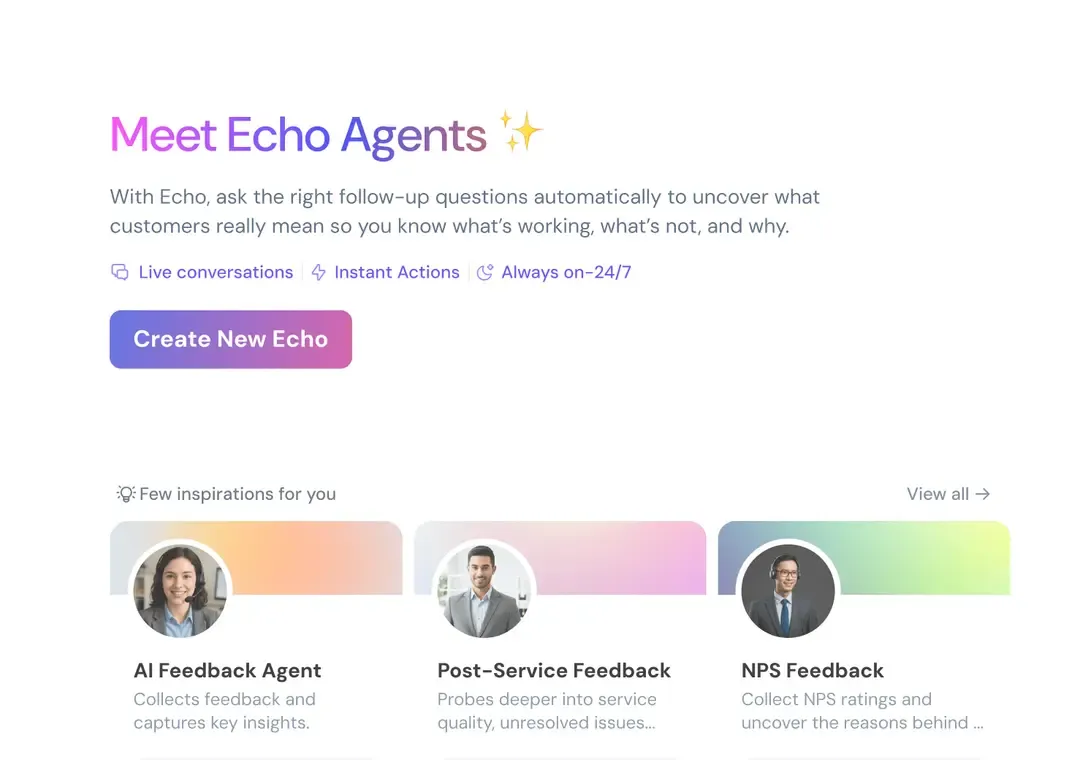
Create a custom agent for any support scenario and measure the KPIs for success on-the-go.

Resolve at the speed of an Echo
TRUSTED BY BEST-IN-CLASS BRANDS