A chatbot is primarily built to have a conversation. An AI agent is built to accomplish a goal.
That distinction matters more than it might initially seem. If a customer asks "What's your return policy?", a chatbot can answer the question. If the customer says "I want to return the shoes I bought last month," an AI agent can check the order, verify eligibility, initiate the return, update the relevant system, and confirm what happens next — without the customer having to navigate each step manually.
The difference is not simply that agents are more advanced chatbots. Modern chatbots can use large language models and conduct sophisticated conversations. The meaningful difference is autonomy, tool use, decision-making, and the ability to execute multi-step tasks toward a defined outcome. For CX teams evaluating both, understanding where that line sits determines which technology fits which problem.
AI agents vs chatbots: The difference at a glance
| Capability | Chatbots | AI Agents |
|---|---|---|
| Primary purpose | Conversation and assistance | Goal and task completion |
| Typical behavior | Reactive | More autonomous |
| Task complexity | Simple to moderately complex | Moderately to highly complex |
| Decision-making | Limited or predefined | Context-dependent |
| Tool access | Often limited | Can use multiple tools and systems |
| Workflow execution | Usually limited | Can execute multi-step workflows |
| Autonomy | Lower | Higher |
| Human handoff | Common for complex requests | Can resolve requests more independently |
| Best suited for | FAQs, informations, routing, basic support | Resolution, automation, complex workflows |
There is some overlap between the two.
A modern AI chatbot can understand natural language, remember context within a conversation, retrieve information, and even perform certain actions. An AI agent can also use a conversational interface.
So the distinction isn't a strict technical line.
Instead, think about the degree of autonomy and action involved.
A chatbot generally helps a customer get somewhere.
An AI agent can potentially get there for them.
What is a chatbot?
A chatbot is a conversational interface designed to understand a user's input and provide a response or guide them through a defined interaction. It is the interface between the customer and the information or process they are looking for.
How chatbots work?
The basic flow is straightforward. The user sends a message, the system interprets the intent, retrieves or generates a response, and replies.
Customer: "Do you ship internationally?"
Chatbot: "Yes. We ship to more than 50 countries. International orders typically arrive within 5 to 10 business days."
What happens in the middle of that exchange has evolved significantly.
- Rule-based chatbots operate on fixed decision trees — they look for specific keywords or menu selections and retrieve the pre-written answer associated with that input.
- NLP-powered chatbots understand the meaning behind a message, handling the same question phrased in multiple ways.
- AI and LLM-powered chatbots generate responses dynamically and can adapt their tone and content to the context of the conversation.
The term "chatbot" no longer automatically means a rigid decision tree — modern chatbots are significantly more capable than earlier versions of the technology.
What chatbots can do
Chatbots are well-suited for interactions where the goal is to provide information, guide a user through a defined process, or collect input.
Chatbots can:
- Answer frequently asked questions
- Help customers find information
- Qualify leads
- Route conversations to the right team
- Perform basic troubleshooting
- Collecting customer details
- Provide product support, and
- Escalating to a human agent when needed
Where chatbots fall short?
Chatbots tend to struggle when a customer needs something beyond information or basic guidance. A chatbot can explain a refund policy. Actually processing a refund requires access to an order management system, an eligibility check, a record update, and a payment workflow. That moves beyond conversation and into task execution — and that is where AI agents become more useful.
What is an AI agent?
An AI agent is an AI-powered chatbot system that can interpret a goal, decide what steps are needed, use tools or systems, and take actions to complete that goal. Where a chatbot facilitates a conversation, an AI agent uses conversation as an interface for accomplishing something.
The key difference is that an AI agent does not just respond to a request — it works toward completing it.
How AI agents work?
The workflow of an AI agent is more complex than a chatbot's. When a goal is received, the agent interprets the context, plans the steps required to reach the outcome, uses tools or connected systems to gather or act on information, evaluates the result of each action, and continues or escalates based on what it finds.
In practice, an AI agent can connect to a CRM, help desk, knowledge base, database, API, order management system, scheduling system, or internal business tool — and act on information from any of them.
What AI agents can do?
AI agents are suited for interactions where the goal is resolution rather than information.
AI agents can:
- Resolve complex support issues end-to-end
- Update customer records
- Process refunds or returns
- Schedule appointments
- Qualify and route leads
- Retrieve information across multiple systems
- Execute multi-step workflows
- Escalate issues based on rules or risk thresholds, and
- Manage proactive customer outreach based on behavioral signals.
What makes an AI agent "agentic"?
There are four characteristics that distinguishes an AI agent from a more passive AI system.
- Goal-oriented behavior. The system works toward an outcome rather than simply responding to each message.
- Reasoning and decision-making. It can determine which step should happen next based on the context of the situation.
- Tool use. It can interact with external systems, APIs, databases, or business applications — enabling it to perform tasks.
- Autonomy. It can complete a sequence of steps without requiring a human to approve each one. The degree of autonomy is shaped by the permissions, guardrails, and escalation rules the business puts in place — but within those bounds, the agent exercises judgment.
AI agents vs chatbots: 7 key differences
The biggest differences between AI agents and chatbots come down to what happens after the customer makes a request.
1. Purpose: conversation vs. goal completion
A chatbot's primary function is to understand what the user is asking and provide a useful response. An AI agent uses conversation as an interface for accomplishing something.
Chatbots are primarily designed around conversation. AI agents are designed around outcomes.
A chatbot might answer: “What are your support hours?”
An AI agent could potentially take a request such as: “Schedule a call with my account manager next week.”
It may need to check availability, find an appropriate time, create the appointment, and send a confirmation.
The customer doesn't really care which AI technology is behind the interaction.
They care whether their problem gets solved.
2. Autonomy: reactive vs proactive
A chatbot generally waits for the customer to provide the next input.
The customer asks a question. The chatbot responds. The customer asks another question. The chatbot responds again.
An AI agent can have more autonomy. Once it understands the goal, it can determine which steps it needs to take next.
That doesn't mean an agent should operate without restrictions. In customer-facing applications, businesses should define what the agent can do independently and when it must ask for confirmation or involve a human.
3. Task complexity: single interaction vs multi-step workflow
A chatbot handles one interaction at a time. An AI agent manages a workflow. It follows a sequence of steps that may involve multiple systems, conditional logic, and different actions depending on what each step reveals.
The difference is not the number of messages in the conversation, but the complexity of the task.
For example:
Customer: “How long does shipping take?”
Chatbot: “Standard shipping takes 3–5 business days.”
An agent can handle a request that requires several steps.
Customer: “My package hasn't arrived. Can you check what's going on?”
An agent could potentially identify the order, check its shipping status, look for delays, determine whether the package needs escalation, and communicate the next step.
4. Tool access and integrations
A chatbot may retrieve information from a knowledge base.
An AI agent can use information from several systems and take actions within them.
This makes integrations a central part of agentic systems.
CRM, ticketing, payment, scheduling, and order management systems all become operational tools rather than reference sources.
5. Decision making
A chatbot follows conversational logic — it selects the most appropriate response from the options available to it.
An AI agent evaluates context and determines what action to take next, which may differ from one conversation to the next depending on the customer's situation.
For a refund request, an agent might evaluate: what did the customer purchase, when, is the order eligible, has it shipped, does the issue require approval, should it be escalated — and then follow the workflow that applies to that specific situation. This makes agents more flexible, depending on the guardrails set.
6. Memory and context
A chatbot typically maintains context within a session — it remembers what was said earlier in the same conversation. An AI agent can work with a broader context: the customer's history across previous interactions, data from connected systems, and persistent information about the account or relationship.
7. Risk and governance
This is the most consequential difference, and the one most comparisons underemphasize. When a chatbot produces an incorrect answer, the customer receives wrong information — a recoverable problem. When an AI agent takes an incorrect action, the consequence can be an unintended record change, a refund issued to the wrong account, an order cancelled in error, or sensitive information exposed to the wrong party.
The greater the autonomy an AI system has, the greater the consequences of a bad decision. AI agents therefore require stronger permissions controls, more rigorous testing, continuous monitoring, clear auditability of every action taken, defined escalation paths, and tighter security controls than a conversational chatbot. This is not a reason to avoid agents — it is a reason to implement them with the same discipline you would apply to any system that can take consequential actions on behalf of customers.
Chatbot vs AI agent: side-by-side examples
Here's what the difference can look like in practice.
Example 1: Order status
Chatbot: “Your order is currently in transit and should arrive on Friday.”
AI agent: Checks the order → checks shipping status → identifies a delay → creates an escalation → informs the customer.
Example 2: Refund
Chatbot: “Our refund policy allows returns within 30 days.”
AI agent: Checks the order → verifies eligibility → initiates the refund → updates the customer record → confirms the refund.
Example 3: Customer onboarding
Chatbot: “Here's our guide to getting started.”
AI agent: Checks the customer's account → identifies incomplete setup steps → guides the customer through them → updates the relevant system.
The chatbot helps the customer navigate the process. The agent can potentially complete the process.
Example 4: Subscription change
Chatbot: "What is your cancellation policy?" — the chatbot explains the options and directs the customer to account settings.
AI agent: "Cancel my subscription." — the agent retrieves the current plan, presents the available options, processes the change in the billing system, updates the account record, and sends a confirmation without the customer leaving the conversation.
The chatbot helps the customer navigate the process. The agent can complete the process.
AI agents vs chatbots for customer service
A chatbot is the right choice when most customer questions are predictable, when customers primarily need information rather than action, when the workflow is simple and well-defined, when human escalation is an acceptable outcome for complex cases, and when the use case does not require access to multiple external systems. For high-volume FAQ handling, lead qualification, basic routing, and information delivery, a chatbot delivers strong results at lower complexity and cost.
An AI agent is the right choice when customers expect their issue to be resolved rather than explained, when the workflow requires multiple steps across different systems, when requests vary significantly in nature, when the system needs to make context-dependent decisions based on the customer's specific situation, and when the goal is to automate resolution rather than deflect to a human.
AI agents vs chatbots: Pros and cons
Chatbot advantages
Easier and faster to deploy. Lower implementation complexity. Effective for high-volume, predictable interactions. Easier to control and test. Lower operational risk. Predictable cost model.
Chatbot limitations
Limited autonomy. Struggles with unexpected or complex requests. Often requires human escalation for resolution. Limited workflow automation capability. Can create friction if customers must repeat information during escalation.
AI agent advantages
Handles complex, multi-step workflows. Can connect to and act across multiple systems. More context-aware across the customer relationship. Can automate resolution end-to-end. Reduces the volume of interactions requiring human involvement.
AI agent limitations
More complex to implement and maintain. Greater security and operational risk when actions go wrong. Requires clean data and reliable integrations to function well. Needs stronger monitoring, governance, and auditability. Higher cost and ongoing maintenance requirements. More difficult to test across edge cases.
How to choose between an AI agent and a chatbot
Start with the customer problem, not the technology. Work through five questions in sequence.
1. Does the customer only need information?
If yes — the customer wants to know something and no action is required — a chatbot is sufficient. If no, continue.
2. Does the customer need an action?
"What is your cancellation policy?" is an information request — a chatbot handles it well. "Cancel my subscription" requires an action. If the customer needs something changed, processed, scheduled, or completed, consider an AI agent.
3. Does the task require multiple steps or systems?
If completing the customer's goal involves more than one step or more than one connected system, an AI agent is the appropriate tool. Multi-step resolution across systems is where agents deliver their most significant value.
4. How much autonomy does the task require?
For low-risk, predictable tasks where the outcome is consistent regardless of context, a chatbot is appropriate. For context-dependent decisions where the right action depends on the customer's specific situation, an agent is better suited. For high-risk tasks, an agent with strong human oversight, clear approval requirements, and defined guardrails is the right choice.
5. What happens if the AI gets it wrong?
This is the most important question. If an incorrect response simply inconveniences the customer, a chatbot handling the task is likely acceptable. If an incorrect action could create financial, legal, security, or customer-impacting consequences, you need stronger controls. The higher the consequence of an error, the stronger the permissions, testing, monitoring, and human escalation that must be built in before go-live.
Can AI agents replace chatbots?
Not necessarily — and the framing of replacement misses the point. AI agents can absorb some chatbot functions, but chatbots remain the more practical choice for high-volume, low-complexity, information-focused interactions where the overhead of an agentic system is not justified.
It is also important to be clear: "agent" is not simply a more advanced marketing term for "chatbot." The two are architecturally different. A chatbot generates responses, whereas an agent plans, acts, evaluates, and continues toward a goal. Conflating the two could lead to misaligned expectations.
The more accurate picture is not one replacing the other, but conversational interfaces and agentic workflows becoming more tightly integrated — with the customer experiencing a seamless interaction while the underlying system decides in real time whether a response or an action is what the situation requires.
AI agents vs chatbots: What's next for customer experience?
The shift underway in customer experience is not from chatbots to AI agents. It is from answering questions to resolving problems, and from automating conversations to automating outcomes.
Instead of telling customers how to update their account, the system can update it for them. Instead of explaining a return process, it can initiate the return. Instead of directing a customer to another department, it can coordinate the workflow itself.
But more autonomy is not automatically better CX. The best AI implementation is the one that gives customers a faster, easier path to the outcome they want — and that is sometimes a chatbot, sometimes an agent, and often both working together. Autonomy should increase in proportion to the business's ability to support it with reliable data, well-designed workflows, clear permissions, and consistent human oversight where the stakes are highest.
Experience the power of 2-in-1: Echo
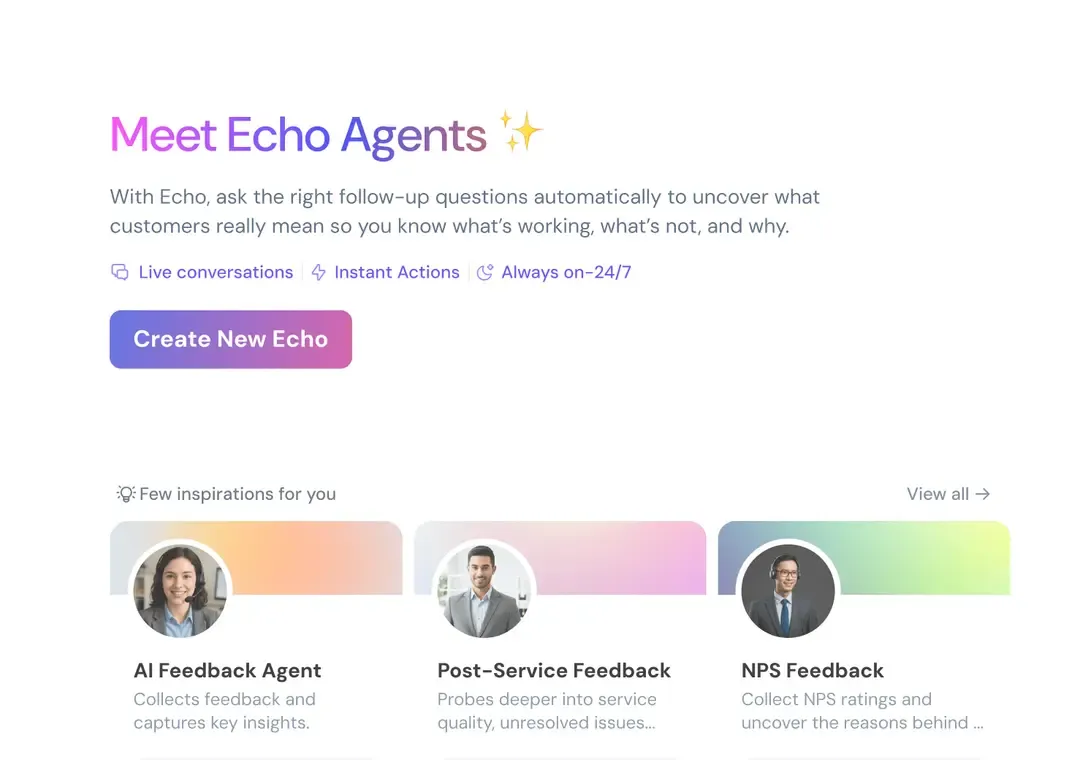
Echo is SurveySparrow's AI agent for customer experience. It goes beyond collecting responses — it asks follow-up questions based on what each customer says, connects to your CRM, helpdesk, and feedback systems, and executes multi-step workflows toward a defined outcome. Where a chatbot would hand off to a human, Echo resolves.

Explore how SurveySparrow can transform your feedback process.
TRUSTED BY BEST-IN-CLASS BRANDS