Employee Experience
Employee Performance Review: Checklist, Tips & Template for Managers
Master effective employees performance reviews with this comprehensive guide, offering actionable strategies, empathetic principles, and practical tools to enhance team productivity and employee engagement.

TRUSTED BY BEST-IN-CLASS BRANDS


Watch Customer Stories

Every team needs an employee performance review. But its value varies according to the way you handle it.
Regardless of the type of review, you need to go beyond ticking boxes if you want to make it a meaningful exercise. So, here’s the ultimate guide to help you design and navigate employee performance reviews – in-person or virtually.
What is a performance review?
An employee performance review is a structured assessment in which a manager evaluates an employee's work performance across their strengths and areas for development over a particular period. A review measures an employee's output and results, along with behavioral and job competencies, goal progress, and career development — giving both the manager and the employee a shared picture of where things stand.
Reviews typically run on an annual or quarterly cycle, though many organizations now supplement these with lighter monthly or weekly check-ins. The formal review is not a substitute for day-to-day feedback. It's the moment where patterns are documented, goals are reset, and development is planned with intention.
Reviews can be yearly, quarterly or even monthly performance check-ins. For example, Adobe replaced conventional reviews with regular check-ins instead of annual check-ins for their employees. Other companies like GE and Deloitte are ditching their legacy performance management systems to focus on one-on-one reviews.
Done well, performance reviews are one of the most direct levers a manager has for improving retention, alignment, and output. Gallup research shows that employees who receive regular, meaningful feedback are 3.6 times more likely to be engaged at work. Without a structured review process, performance gaps go unaddressed, high performers go unrecognized, and career development conversations never happen.
Reviews also serve a practical function at the organizational level. They create the documented record that informs compensation decisions, promotions, and performance improvement plans. They surface whether underperformance is individual or structural. And when run consistently, they give managers the data to distinguish a temporary dip from a deeper problem.
Types of Performance Reviews
Not all performance reviews follow the same format. The right type depends on your team size, review frequency, and what you're trying to measure.
1. Annual performance review
An annual review is a comprehensive assessment of an employee's performance over 1 year. Most organizations use annual reviews as the basis for compensation and succession planning.
2. Quarterly performance review
A quarterly performance review covers a shorter window and focuses more tightly on goal progress and near-term priorities. It gives managers a regular checkpoint to course-correct before small issues compound, without waiting twelve months to address them.
3. 360-degree feedback review
A 360-degree review is part of the overall performance review process where employers collect feedback on a subject from multiple sources: the employee's manager, peers, direct reports, and sometimes customers. It gives a fuller picture of how an employee performs across relationships and contexts, not just in the eyes of one person.
Earlier, there were 90-degree performance reviews where only the employee's direct reporting manager would review their performance and provide ratings.
The 360-degree feedback system has become a preferred choice over 90-degree reviews considering the fairness of reviews and the empowerment of employees to submit a self-evaluation.
4. Self-evaluation
A self-evaluation is a contributing part of a 360-degree review. A self-evaluation/assessment requires employees to assess their own performance before the formal review meeting. It surfaces the employee's perspective on their strengths and gaps, and gives managers a reference point for where perceptions align or diverge.
Here is how an employee self-assessing themselves would look like.
- "I've improved how I present updates in team meetings — I now lead with decisions and action items. My written briefs are still longer than they need to be, and that's what I'm focused on fixing."
- "I hit two of my three Q2 targets. The retention goal came in at 87% against a 90% target — two enterprise churns I didn't flag early enough were the main factor."
- "I work well when roles are clearly defined. In ambiguous projects, I tend to hold back rather than step in. I've been making a deliberate effort to change that on the current product launch."
- "I meet individual deadlines consistently but struggle when two large projects overlap. In Q3, the rebrand and website migration clashed in the final week and both suffered. I want to get better at escalating earlier."
- "I took on informal mentoring for two junior team members this half and I think I'm ready for something more formal. Giving critical feedback is still an area I need to work on — I tend to soften it more than I should."
Read more: 50+ Examples of Self-Assessments
5. Peer review
A peer review gathers feedback from colleagues who work directly with the employee. It's particularly useful for assessing collaboration, communication, and team contribution, areas a manager may not observe directly. Like the self-assessment, peer reviews are a contributing part of the 360-degree feedback system and is useful for finding strengths and skill gaps by comparing it with self-ratings.
6. Continuous check-ins
Continuous check-ins are informal, recurring conversations between a manager and employee, and is typically conducted on a weekly or biweekly basis. They don't replace the formal review, instead they're a part of the performance review where feedback is kept continuous and timely.
The role of performance reviews
Performance reviews serve more than one function — they inform decisions, surface gaps, and give employees the feedback they need to grow.
- Measure what matters. Reviews quantify key metrics like engagement, productivity, time management, and overall output, giving managers a data-backed view of each employee's contribution.
- Understand strengths and gaps. A structured evaluation helps managers understand what each employee does well and where they need support, making it easier to assign work and plan development.
- Set clear expectations. The review process gives managers and employees a shared reference point for what good performance looks like in a specific role.
- Inform key decisions. Performance data directly informs compensation, promotions, bonuses, and where necessary, performance improvement plans.
- Drive retention. Employees who receive regular, structured feedback are more likely to stay engaged and committed. Reviews signal that the organization is paying attention.
- Plan the next stage. A good review looks forward as much as it looks back — mapping out the employee's next development goals and the organization's expectations for the period ahead.
- Identify systemic issues. Patterns across multiple reviews can reveal whether underperformance is individual or rooted in a structural problem within the team or organization.
The three principles of a performance review
Before the pandemic, an employee performance review was once-in-a-while event. But after the Great Resignation, more companies began to realize the importance of mental health in employee performance.
That’s why leading companies like Facebook, Sprinklr, and SNI are increasing regular check-ins. In this post-pandemic era, employers can follow these three principles for conducting performance reviews in a more empathetic way.
- Be Compassionate: Humans are the core of your company, and which human hasn’t had a bad day? Measuring performance is essential but make sure to stay empathetic and understanding while conveying the feedback. Make sure to check in not just on their work performance but their their mental wellbeing too. Be flexible with work schedules where required.
- Embrace a Growth Mindset: You’d be surprised at how many employees dread performance reviews under the assumption that they focus on negative areas. During a crisis, this kind of belief can develop a feeling of failure and inferiority. That’s why you should encourage your people to adopt a growth mindset. Emphasize the fact that employees can take steps or training to work on their weaknesses. Also, be compassionate with employees who are unable to deliver the expected results despite previously performing well.
- Check-in Regularly: For this post-Covid workplace, frequent communication is a must.Instead of conducting yearly reviews, check-in with them regularly to track their progress and challenges. For instance, using survey tools, you can use automated check-ins to monitor progress.
89% of HR leaders say that ongoing peer feedback and check-ins are critical for successful outcomes.
Employee performance review: An eight-step checklist
- Set clear goals and standards
- Keep track of your employees’ progress
- Utilize the 360-degree feedback system
- Send a self-assessment beforehand
- Run the review meeting with structure
- Deliver feedback that is specific
- Build a development plan
- Follow up and close the loop
1. Set clear goals and standards
Clear goals are the foundation of any useful performance review. Without them, the conversation has no reference point and feedback becomes subjective. Before the review cycle begins, define what success looks like for each role — specific, measurable outcomes that both the manager and employee agree on upfront.
For example, you are the lead of a sales team, Your quarterly goal is to bring in $60,000 in sales per quarter per salesperson. When you do a quarterly performance review, this is the standard that you will apply.
Once you set the goals and standards for each employee, arrange a meeting, and share them with your entire team. This will help your employees know what you expect from them when it’s time for the employee appraisal.
2. Keep track of your employees’ progress - continuously
A performance review is only as good as the data behind it. Tracking performance throughout the cycle, not just in the week before the review, helps
Let’s say you notice that one of your employees was absent for two days without informing anyone. Or maybe someone worked overtime and on the weekends to complete a project. You can record these events on your assessment file and use this information during the employee performance review.
Heads up: If someone does an exceptionally great job, don’t wait for a year to tell them so! Give immediate feedback – this is a huge morale booster and boosts employee engagement with their jobs.
Organizations with highly engaged employees are 21% more profitable than others.
Celebrate Wins & Recognize Contributions With Meaningful Rewards
3. Utilize the 360-degree feedback system
A manager's view of an employee's performance is one perspective. Collecting input from peers, direct reports, and cross-functional collaborators gives a more complete and accurate picture. This is especially important for assessing soft skills like communication, collaboration, and leadership — areas a manager may not directly observe.
360-degree feedback software, like SurveySparrow, automate employee performance reviews so that you can focus on actually drawing out insights that will help the employees.

Filters for self-assessed, partially evaluated, and report-ready status let you track exactly where each employee stands in the process.
4. Send a self-assessment beforehand
Ask employees to complete a self-assessment before the review meeting. It gives them time to reflect on their own performance, which leads to a more honest and productive conversation. It also surfaces gaps in perception early — if an employee rates themselves significantly higher or lower than you do, that's worth exploring before you're sitting across from each other.
Keep the self-assessment focused. Ask about their strongest contributions in the period, where they fell short and why, and what support they need going forward. Align these questions with the goals set at the start of the cycle.
5. Run the review meeting with structure
Set the tone for the meeting by saying that it is a two-way conversation, not a verdict.
Walk through the reviewee's goal progress first, then peer feedback, and then development. Give the employee time to respond to each area before moving on.
Come prepared with specific examples for every point you raise.
Avoid providing vague feedback — "you need to communicate better". This gives the employee nothing to act on.
Specific feedback on the other hand is better — "in the Q2 project handoff, the delay in flagging the scope change created a week of rework for the design team".
This gives them something concrete to understand and address.
6. Deliver feedback that is specific and documented
Feedback only drives change when it's clear and recorded. After the meeting, document an MoM (Meeting of Minutes) what was discussed: the ratings, the key feedback points, the agreed actions, and any commitments made on both sides. This creates accountability and gives both parties a reference point for the next review.
Avoid evaluating personality. Review their behavior and output, and not character.
7. Build a development plan
Every review should end with a forward-looking plan. Identify one or two areas for development, agree on the specific actions that will address them, and assign a timeline. This might mean a training program, a stretch assignment, a mentorship pairing, or simply a change in how work is structured.
The development plan is also where you address high performers. Recognition matters, but so does growth. If a strong employee has no development path, the review has done half its job.
For average-to-poor performing employees, consider running a performance improvment plan (PIP) to help them improve and achieve the performance standards set by you.
8. Follow up and close the loop
The review meeting is not the end of the process. Schedule a follow-up conversation within 30 days to check progress against the agreed actions. This signals that the review was a real commitment, not a box-ticking exercise.
Regular check-ins between formal reviews reinforce the feedback and keep development on track. Employees who see their managers following through on review commitments are far more likely to take the process seriously themselves.
Pro tip:
If one of your employees has achieved a milestone, or completed a project, make sure to celebrate their wins. Rewards and recognition will boost your employees’ mood and productivity. Even simple rewards like a gift voucher, a team night out, or dinner or movie nights will make them feel valued and cared for.
You can use this Employee Incentive Questionnaire to understand what benefits or rewards they like to receive. This way, you can create a rewards policy that employees will love.
Employee performance review template
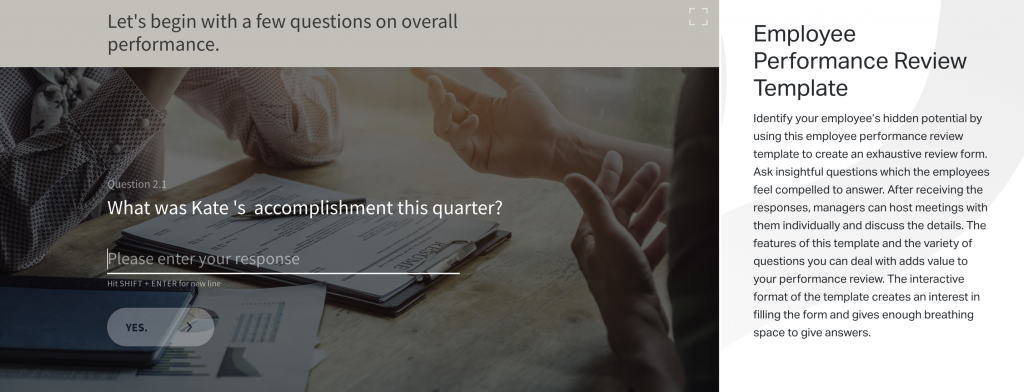
A good template gives the review structure without making it feel mechanical. The one below covers the core elements of a well-run review: goal progress, competency ratings, open-ended feedback, and a development plan. It's built as a conversational survey, so employees engage with it naturally rather than filling out a static form.
You can customize it with your own brand kit, question set, and scoring criteria. Use it as the manager-facing review form, the employee self-assessment, or both.
Employee performance review: Top six tips to evaluate effectively
- Be specific with every data point. When you are setting a performance standard or goal, make it as specific as possible. Instead of telling them to improve productivity or work hard, how about “improve your team collaboration ability,” “improve your communication skill while attending a video conference,” “learn to operate a new tool,” etc.
- Be honest about both sides of performance. Sometimes, managers tend to share only good feedback with the employees and gloss over the bad. But, it’s important to share both when it comes to performance reviews so they can learn from the feedback. Similarly, it’s crucial to set realistic goals.
- Don’t evaluate personality. Judge the performance, not their character. For instance, don’t evaluate traits like “immature,” “practical,” or “emotional.” Rather evaluate their performance based on a certain task. Keeping feedback tied to observable behavior protects the integrity of the process and reduces the risk of bias.
- Listen as much as you speak. A performance review is a conversation, not a presentation. Give the employee space to respond to feedback, raise concerns, and share their own read on the period. What they say often contains information a manager wouldn't otherwise have — workload issues, unclear priorities, team dynamics that affect output.
- Never compare employees to each other. Each employee's performance should be evaluated against their own goals and standards, not against a colleague. Comparisons create resentment, distort the feedback, and shift the focus away from individual development. The review is about this employee, this role, and this period.
- Ask questions that go beyond the task list Conversation is the key to keep your employees emotionally connected. So use a mix of performance and health-related questions to dig deeper. For instance: “What was your biggest challenge while working on a project,” “what new skills would you like to improve this year,” “how are you coping with the current situation,” “what support or work adjustment you need,” etc.
Related: How to write performance review comments.
Common mistakes to avoid in employee performance reviews
Even well-intentioned reviews go wrong in predictable ways. These are the most common pitfalls and what to do instead.
1. Recency bias
Recency bias happens when a manager's assessment is shaped primarily by events from the last few weeks of the review period, overshadowing months of prior performance. A strong finish can mask a difficult year, and a rough patch before the review can unfairly define an otherwise solid one. Continuous performance tracking throughout the cycle is the only reliable fix.
2. The halo and horn effect
One standout achievement or one visible failure can color an entire review. A manager who saw an employee handle a difficult client well may unconsciously rate them higher across every competency. The reverse is equally common. Evaluate each area independently, using specific evidence for each rating.
3. Skipping the preparation
Walking into a review without preparation produces generic feedback, missed observations, and a conversation that feels improvised. Both the manager and the employee should prepare in advance — the manager with performance data and specific examples, the employee with a completed self-assessment.
4. Making it a one-way conversation
A review where the manager speaks and the employee listens is not a review — it's a briefing. Employees who feel unheard during their review are less likely to act on the feedback. Build in structured time for the employee to respond, push back, and ask questions.
5. No follow-through after the meeting
A review that produces no follow-up action is quickly forgotten. If the development plan and agreed actions aren't revisited within 30 days, both parties learn that the review is a formality. Follow-through is what gives the process credibility.
Let’s wrap up!
With our performance review checklist, you’ll be on the road to creating an engaged workforce. This checklist not only helps you to enhance employee skills but also ensures company growth for the long-term.
However, remember that performance reviews aren’t a one-way road, where the employers talk and employees listen to the feedback. In today’s world, it’s all about conversations. So, listen to your employees well, and provide them great performance reviews that will help them grow personally and professionally.
Watch Customer Stories